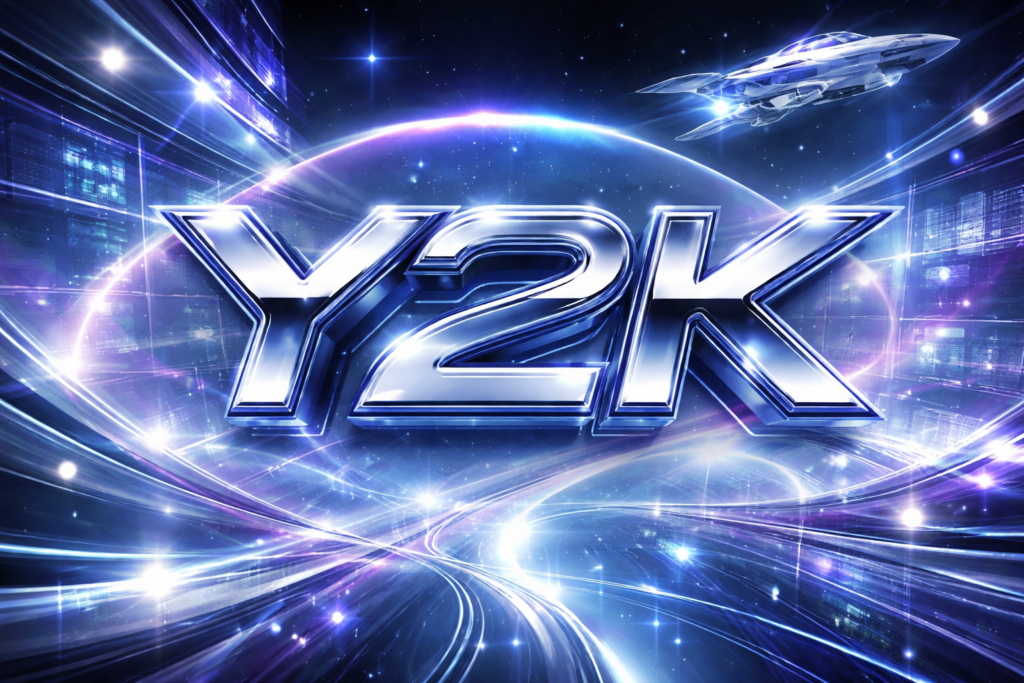
Y2K Futurism is the design language that emerged in the late 1990s and early 2000s, shaped by the belief that the year 2000 marked a hard break with the past. It imagined the future as imminent, legible, and engineered for our enjoyment. Mid-century modernism became new century utopianism. Once again, we imagined technology as embedded into everything we do, shaping our aesthetics rather than vice versa. Translucent plastics, chrome finishes, rounded forms, and glowing interfaces signalled progress you could see and touch. The future was clean, fast, and completely consumable.
visit the Chrome&Candy product portal TO SEE WHAT’S STILL CONSUMABLE.
Products like Apple’s iMac G3 and films such as The Matrix encoded futurism into everyday life. Screens became portals. Interiors echoed control rooms and airport lounges, with curved walls and integrated lighting. The fashion industry overflowed with synthetic fabrics, metallic touches and aerodynamic silhouettes. The future was no longer distant. It was immediate. It was encoded in neon binary. But most importantly, it was branded.
Y2K Futurism now reads as a vision waiting to be reanimated. Its optimism is welcome in a world being rewritten by artificial intelligence. Like a xenomorph, its dormancy is just part of the process. As Millennial modernism reemerges from hypersleep, humanity must capitalise fully on its clear visual and conceptual language. Its revival should not prompt nostalgia. It is entirely preparatory. Y2K Futurism offers us a framework for a new space age where Mars is within reach; where science fiction becomes lived experience; and where the future is finally here.